
The Leather
Grading & Measuring
Quality isn't expensive. It's priceless.
Crocodile skin prices move with market demand, supply and exchange rates — based on two factors: grade and size. The better the grade and the larger the size, the more valuable the skin. Ricco supplies luxury brands, artisans and individual buyers with the finest skins at the best value.
The cut
Why we supply belly skins only
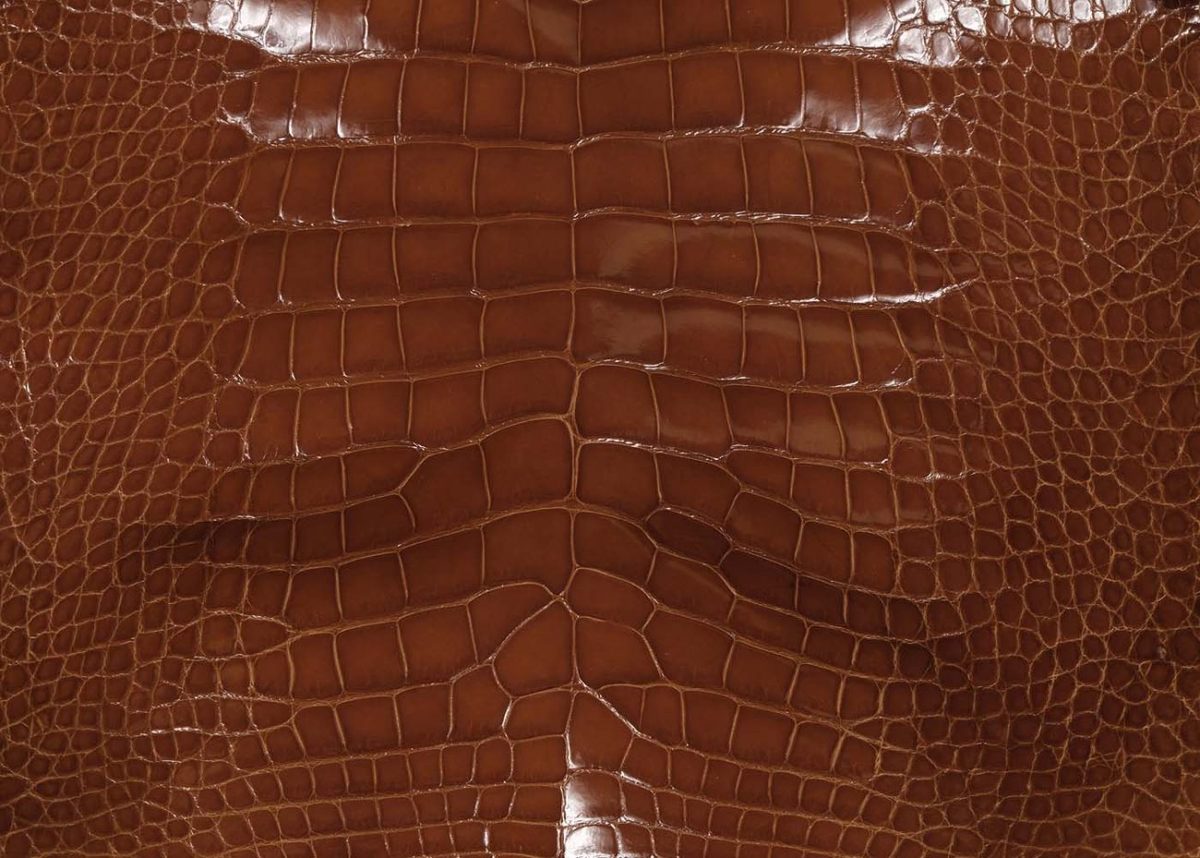
Ricco supplies belly skins only. The belly is the underside of the animal, opened along the flanks so the hide lies flat: small rectangular scales in the centre, growing rounder towards the sides, with no bone in the cutting area. It is the cut used for handbags, small leather goods and watch straps — and the only cut that can be graded and measured consistently, skin after skin.
You will see hornback and backstrap offered elsewhere — the bony back of the animal, and a narrow strip taken along the spine. We do not supply them. Every skin we list by centimetre is a belly skin, measured across its widest point.
Grading
Grade by defect quadrants
| Defect (quadrants) | Grade |
|---|---|
| 0 quadrant(s) | Grade 1 |
| 1 quadrant(s) | Grade 1/2 |
| 2 quadrant(s) | Grade 2/3 |
| 3 quadrant(s) | Grade 3/4 |
| 4 quadrant(s) | Grade 4/5 |
Measuring of skins
How is crocodile measured?
Crocodiles are measured in centimetres, by placing a ruler east–west across the belly. The skin must be flat; the measurement is taken edge to edge, excluding the outermost half-bone, with partial centimetres rounded down.
Ex: a skin measuring 46.5 cm is recorded as 46 cm.
Sizing
What each width can make
Belly width decides what can be cut from a single skin without splicing. As a working guide:
| Belly width | Typically yields | Notes |
|---|---|---|
| 25–29 cm | Wallets, card holders, watch straps, small leather goods | Tight scale pattern; the most economical way to buy crocodile |
| 30–34 cm | Long wallets, clutches, small bags, spliced belts | Belts usually need splicing at this width |
| 35–39 cm | Medium bags, tablet and folio cases | Scales noticeably larger towards the flanks |
| 40 cm and above | Large handbags, briefcases, attaché cases, luggage, garment | A 16-inch handbag generally needs 40–44 cm |
If you are unsure, send us the finished dimensions of your piece rather than a skin size — we will tell you which width cuts cleanly and how many skins the run needs.
Pricing
How grade and size set the price
Crocodile is quoted per centimetre of belly width, not per skin and not per square foot. A price per centimetre is agreed for a given species, grade and finish; the invoice for one skin is that rate multiplied by its measured width.
Two skins of the same width can still be priced differently, because grade moves the rate. A Grade 1 skin — no defect in any quadrant of the cutting area — commands the highest rate; each additional affected quadrant lowers it. Size moves it too: larger skins are rarer, and the rate per centimetre rises as width increases rather than staying flat.
This is why a quotation always names three things together: species, grade, width range. Ask for a price without them and any number you receive is meaningless.
Reference
Types of skin defects
Healed Scars
Old battle wounds and bite marks. Closed grain — may be acceptable in the cutting area depending on the project.
Open Scars / Cuts
Wounds that were fresh and unhealed. Open grain — typically cannot be included in the cutting area.
Holes
From scars or cuts that opened during tanning (drum rotation), or from poor skinning technique.
Parasites
Tiny round "bored" holes from leeches — found only on wild crocodiles; may be healed or open.
Wide Umbilical Scars
More prevalent in farm-raised animals, rare on wild crocodiles; causes are debated.
Wrinkling
Occurs in both farmed and wild skins — from raw-skin issues (rapid weight loss, diet) or tanning.
Grain Damage
From improper raw-skin preservation, or poor tanning causing overheating and burning of the skin.
Bones / Buttons
Osteoderms that form in the skin — found in the neck and upper belly of larger wild crocodiles, rare in farmed.
Enquiries
How to specify an order
A complete enquiry lets us quote in one reply instead of three. Tell us:
- Species — Crocodylus porosus, Crocodylus niloticus or Alligator mississippiensis
- Width range — in centimetres, or the finished dimensions of the piece you are making
- Grade — or describe where defects are acceptable in your cutting layout
- Finish — semi-matte, millennium, garment, nubuck or Himalayas
- Colour — a standard colour from stock, or a swatch to match
- Quantity — and the destination country for export paperwork
Contact
Need a specific grade or size?
Tell us your requirements — we will source the right skins for your project.