
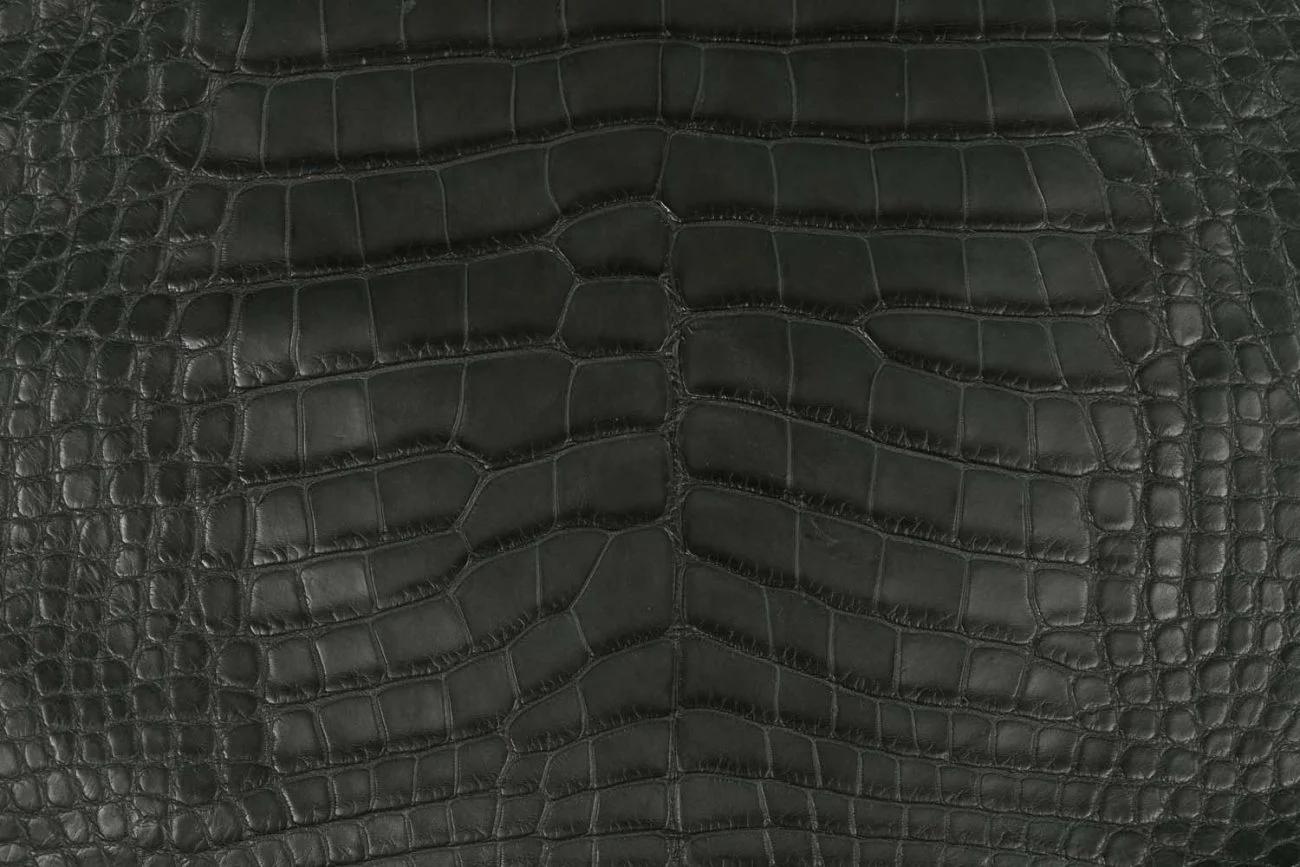
Short answer: a crocodile belly skin is measured in centimetres, edge to edge across the belly, with partial centimetres rounded down. It is graded by how many of the four quadrants of the cutting area carry defects: none is Grade 1, and each extra affected quadrant moves it down a grade.
How a skin is measured
The ruler is placed east–west across the belly, with the skin lying flat. The measurement is taken from edge to edge, excluding the outermost half-bone, and partial centimetres are rounded down: a skin of 46.5 cm is recorded as 46 cm. Only belly skins can be measured consistently this way, which is why we supply nothing else.
How a skin is graded
The cutting area is divided into four quadrants, and the grade follows the number of quadrants that carry defects.
| Quadrants with defects | Grade |
|---|---|
| 0 | Grade 1 |
| 1 | Grade 1/2 |
| 2 | Grade 2/3 |
| 3 | Grade 3/4 |
| 4 | Grade 4/5 |
The grade is about where the defects sit, not only how many there are. If your layout lets a defect fall in a part you will not use, a lower grade can still suit the product.
What counts as a defect
- Healed scars: old wounds and bite marks with closed grain; may be acceptable in the cutting area depending on the project.
- Open scars and cuts: unhealed wounds with open grain; typically cannot be included in the cutting area.
- Holes: scars or cuts that opened during tanning, or poor skinning.
- Parasites: tiny round holes from leeches, found only on wild crocodiles.
- Wide umbilical scars: more common in farm-raised animals.
- Wrinkling: from raw-skin issues or tanning; appears in farmed and wild skins.
- Grain damage: from poor preservation or overheating in tanning.
- Bones / buttons: bony deposits in the neck and upper belly of larger wild crocodiles.
What each width can make
| Belly width | Typically yields |
|---|---|
| 25–29 cm | Wallets, card holders, watch straps, small leather goods |
| 30–34 cm | Long wallets, clutches, small bags, spliced belts |
| 35–39 cm | Medium bags, tablet and folio cases |
| 40 cm and above | Large handbags, briefcases, attaché cases, luggage, garments |
A 16-inch handbag generally needs 40–44 cm. If you are unsure, work from the finished dimensions of your piece rather than a skin size.
Using this when you order
Width and grade are two of the six things to specify in an enquiry. See the buyer’s checklist for all six, and the five finishes explained for the fourth. Our grading and measuring page has the full reference.
Questions buyers ask
Is a lower grade a bad skin?
No. It means more quadrants carry defects. If your pattern avoids them, a lower grade can be the sensible choice.
Why are skins measured across the belly?
The belly is the cut that can be measured and graded consistently, skin after skin.
How do I choose a width?
Start from the largest piece you need to cut, then use the table above. For skins, see the portfolio or contact us.