
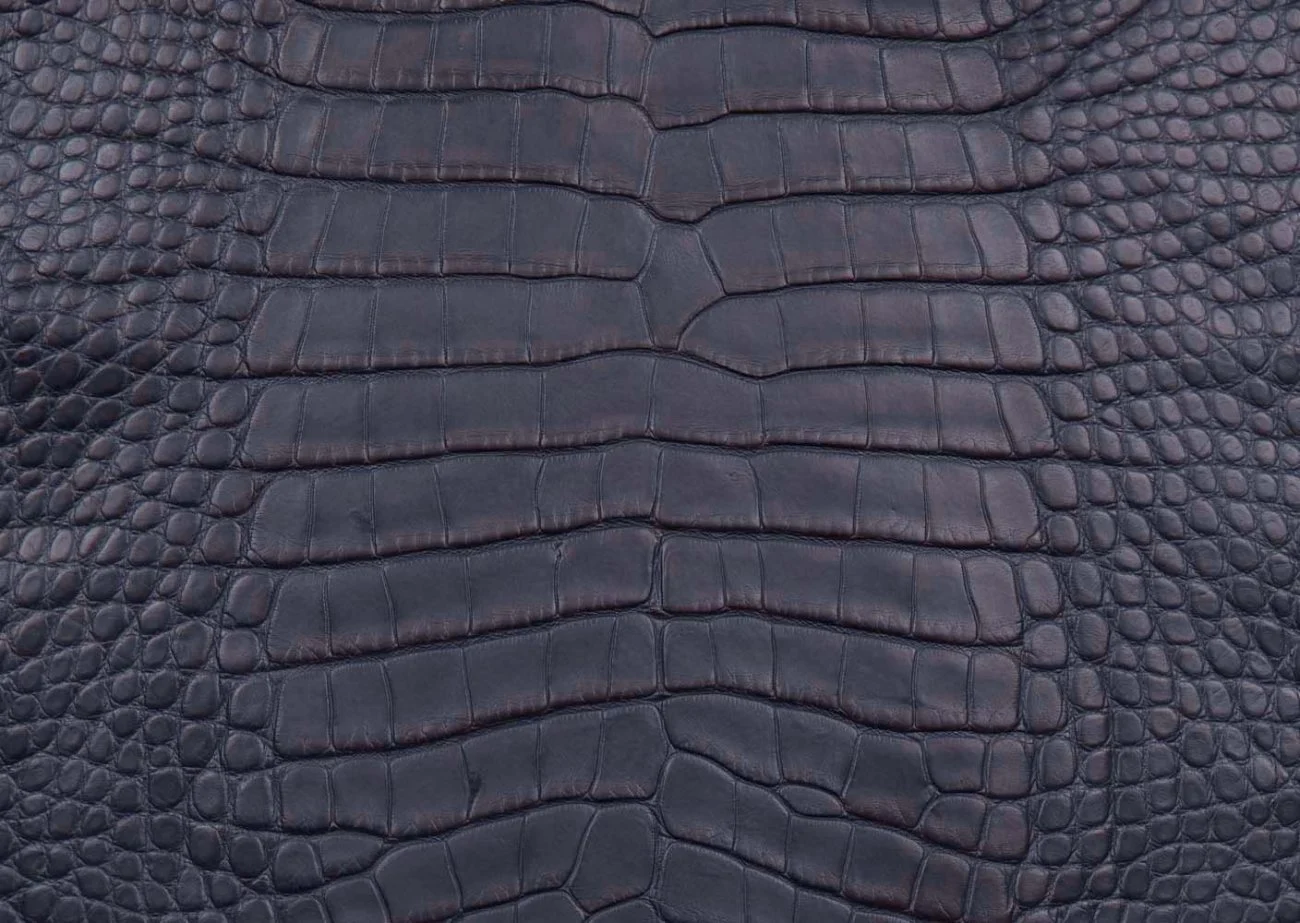
Short answer: Porosus has the largest, most symmetrical belly tiles with a single pore per scale; Niloticus has small, tight, even tiles; American alligator is recognised by the umbilical rosette in the centre of the belly. All three are used for luxury handbags, small leather goods, watch straps and belts — the choice comes down to look, size and structure.
At a glance
| Porosus | Niloticus | American alligator | |
|---|---|---|---|
| Animal | Saltwater crocodile (Crocodylus porosus) | Nile crocodile (Crocodylus niloticus) | American alligator (Alligator mississippiensis) |
| Origin | Southeast Asia | Africa | USA |
| Look of the belly | Large, symmetrical tiles; one follicle pore per scale | Small, even, tightly packed tiles | Soft, structured; umbilical rosette at the centre |
| Belly width in our portfolio | 30–60 cm | 25–40 cm | 25–39 cm |
Porosus: the large, symmetrical belly
Porosus is the saltwater crocodile and the skin most often described as the top of exotic leather. Its belly tiles are large and symmetrical, and each scale carries a single follicle pore — the signature that separates it from other species. The larger widths make it the natural choice for big handbags and statement pieces. See the Porosus belly in our portfolio.
Niloticus: the refined, tight pattern
Nile crocodile gives a fine pattern of small, even tiles. The grain is precise and delicate, which is why it is favoured for structured bags and small leather goods, where a regular, tight pattern reads clearly even on small panels. See the Niloticus belly.
American alligator: the rosette
An alligator is not a crocodile — it is a different animal, and its belly is easy to identify: the umbilical scar (rosette) sits in the middle of the skin. Alligator is soft yet holds its shape, a long-standing staple of luxury leather goods. See the Alligator belly.
Which one for which product?
- Large handbags, statement pieces: Porosus — the widest skins and the largest tiles.
- Structured bags, wallets, small leather goods: Niloticus — a tight pattern that stays regular on small cuts.
- Soft-structured bags, a distinctive centre: Alligator — if the rosette is part of the design.
The finish changes the look as much as the species. Read about our five finishes and how skins are graded and measured before you choose.
Questions buyers ask
Is alligator the same as crocodile leather?
No. They are different animals with different belly patterns; alligator carries the umbilical rosette, crocodile does not.
How is the size of a skin measured?
In centimetres across the belly, edge to edge, on a flat skin. Details are on our grading page.
Can I request a specific species, grade and finish?
Yes — tell us the species, finish, width and grade you need via the contact page.