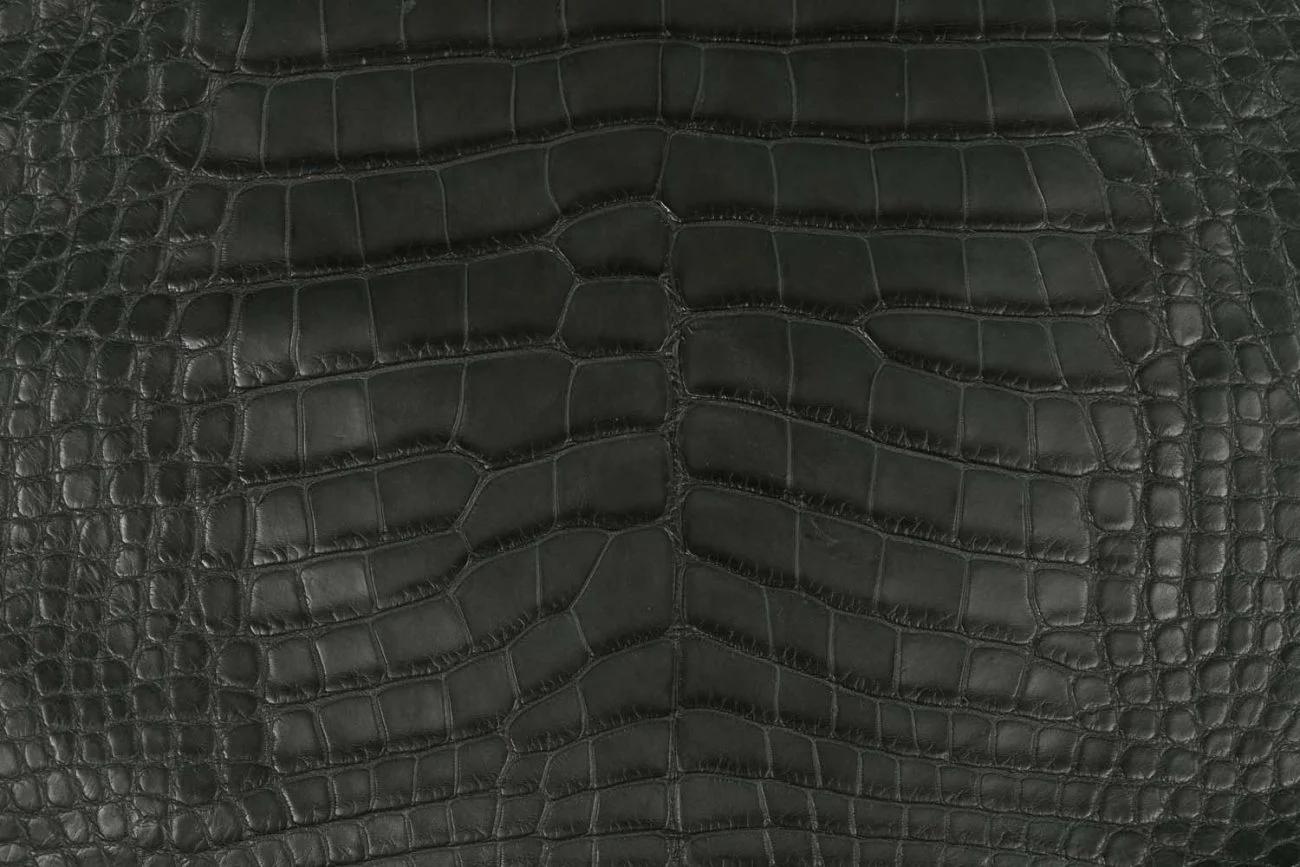
Short answer: genuine crocodile leather is never perfectly uniform. The tiles change size from the centre of the belly to the flanks, the pattern does not repeat, and the reverse side is real hide. An embossed imitation repeats the same pattern, looks too regular, and its back is often fabric or a coated layer.
Six checks you can do in a minute
1. Look for natural variation
On a real skin the centre of the belly carries the largest, most regular tiles; towards the flanks they become smaller and less regular. Embossed leather is stamped from a plate, so the same group of tiles repeats across the surface. If you can find the same shape twice, be suspicious.
2. Look at the pores
Each species leaves its own signature. On Porosus belly there is a single follicle pore on each scale; American alligator is recognised by the umbilical rosette in the middle of the belly. See the three species side by side in Porosus vs Niloticus vs Alligator. Imitations print or press a uniform dot, or have none at all.
3. Turn it over
The reverse of genuine leather is a fibrous, suede-like surface. A woven or knitted backing, a smooth plastic layer, or a backing that is clearly different from the front means a coated or laminated product.
4. Check the edges and the cut
A cut edge on real leather shows dense fibres right through the thickness. A cut edge of an imitation shows layers: coating, a foam or fabric core, a separate backing.
5. Flex it
Crocodile leather is flexible and the tiles stay defined as it bends; the creases form between the tiles. A coated surface tends to crack or whiten along the crease, or feels stiff and plastic.
6. Consider the finish
The finish changes the look of a genuine skin — from soft matte to high gloss to nubuck — so a real skin can look very different. Do not judge only by shine. Our five finishes explain what each one does to the surface.
Embossed leather is not always “fake”
Crocodile-embossed cowhide is a legitimate product when it is sold honestly as embossed leather. The problem is only when it is sold as genuine crocodile. If a sale matters, ask the seller for the species, the cut (belly, flank or back) and the grading — real suppliers will state them. Read how skins are graded and measured.
Questions buyers ask
Is a very regular pattern a good sign?
Usually the opposite. Natural skin has variation; perfect repetition suggests stamping.
Can one check prove it?
No single check is conclusive. Use several together — pattern, pores, reverse side, edge and flex.
Where can I see genuine skins?
Our portfolio shows the three belly lines we work with. If you need skins for production, contact us.