The Leather
Crocodile leather, explained by a tannery
Crocodile leather is the tanned skin of farm-raised crocodilians — crocodiles and alligators — and one of the most valuable leathers made. Its value comes from the scale pattern: no two skins are alike, the pattern cannot be copied exactly, and a well-tanned skin outlasts the piece it is made into.
This guide covers what buyers ask us most often: how the species differ, which part of the skin is used, how quality is graded and measured, how finishes change the leather, how to tell a real skin from an imitation, and what paperwork travels with it. We are a tannery in Ho Chi Minh City; everything here comes from the skins we grade and finish every day.
Species
Crocodile, alligator or caiman?
"Crocodile leather" is used loosely for several species. They look alike at a glance and differ a great deal in the hand and in price. We tan three, all from farms with documented origin, and every skin carries CITES documentation:
| Species | Belly width at Ricco | How to recognise it | Character |
|---|---|---|---|
| Crocodylus porosus Saltwater crocodile | 30–60 cm | Small, square, very even belly scales, with a tiny sensory pore on each scale. | The most regular pattern, and the most valuable of the three. |
| Crocodylus niloticus Nile crocodile | 25–40 cm | Slightly larger, more rectangular scales, with a pore on each scale like every true crocodile. | A consistent pattern, a little bolder than Porosus. |
| Alligator mississippiensis American alligator | 25–39 cm | No pores on the scales, and a cluster of irregular scales at the umbilical scar mid-belly. | Supple, with a softer, more organic pattern. |
Caiman is often sold as crocodile. Its belly scales carry bony deposits that make the leather stiffer and leave visible lines across the scales. It is a cheaper leather and we do not supply it.
The cut
Belly, hornback and backstrap
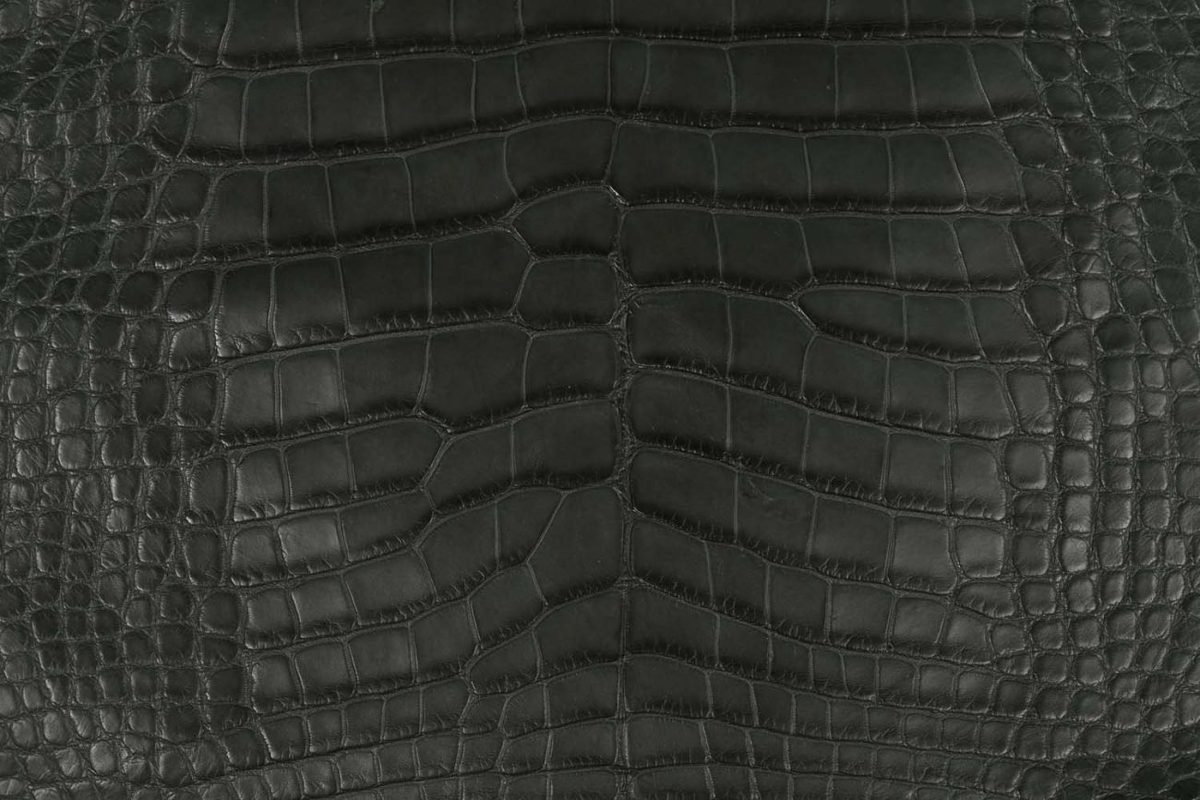
A skin can be opened in different ways. Opened along the back, it gives a belly skin: small rectangular scales in the centre, growing rounder towards the flanks, with no bone in the cutting area. Opened along the belly, it gives a hornback skin with the bony ridges of the back on show. A backstrap is a narrow strip taken along the spine.
Belly is the cut used for handbags, small leather goods and watch straps, and the only cut that can be graded and measured consistently. It is the only cut we supply.
Quality
How quality is judged: grade and width
Two numbers describe a crocodile skin. The grade counts how many quarters of the cutting area carry a defect — scratches, healed bites, scale damage, holes. Grade 1 has none; each affected quarter lowers the grade, down to Grade 4/5. The width is measured across the belly at its widest point, in centimetres, rounded down.
Together with the species and finish, these set the price: crocodile is quoted per centimetre of belly width, not per skin. Width also decides what a skin can make — a wallet needs far less than a large handbag.
Finishes
Finishes change the leather, not just the look
The finish is the result of every step after tanning: how the skin is dyed, milled, pressed or left alone. It changes the drape, the hand and how the leather ages. We work in five finishes: Semi-Matte (low gloss, vintage), Millennium (pressed, very soft), Garment (shaved thin for clothing and soft bags), Nubuck (buffed, water-repellent) and Himalayas (unbleached, natural colour shift).
Authenticity
Real crocodile or embossed imitation?
Most "crocodile" in shops is cowhide pressed with a crocodile pattern. It can look convincing in a photo. In the hand, these are the signs we look for:
- The pattern changes across the skin. On a real belly, scales are smallest and most regular in the centre and grow larger and rounder towards the flanks. An embossed pattern repeats at the same size everywhere.
- Every scale is slightly different. Real scales vary in shape and spacing. A stamped plate repeats exactly, often visibly where two impressions meet.
- Pores on crocodile scales. True crocodiles have a tiny pore on each belly scale. Embossed leather and alligator have none.
- The creases are real. Between real scales the leather folds into natural grooves. On embossed leather the grooves are printed into a flat surface and stay shallow when you bend it.
- The paperwork matches. Raw and finished crocodile skins in international trade travel with CITES documents. A seller who cannot name the species or show the paperwork is selling something else.
CITES
CITES: the paperwork that travels with every skin
Crocodilians are protected under CITES, the international treaty on wildlife trade. Every skin we ship travels with CITES documentation. Tell us the destination country when you enquire, so the export paperwork is prepared for it.
Care
Caring for crocodile leather
- Keep it dry. If it gets wet, blot with a soft cloth and let it dry at room temperature, never near a heater or in direct sun.
- Wipe dust away with a soft, dry cloth. Condition rarely, with a product made for exotic leather, and test it on a hidden spot first.
- Store pieces stuffed to keep their shape, in a breathable dust bag, away from heat and humidity.
- Semi-matte surfaces show scratches more than buffed ones; Nubuck repels water but should not be soaked.
Ricco
Working with Ricco
Ricco is a crocodile leather tannery in Ho Chi Minh City, Vietnam, exporting finished belly skins to Europe, Russia, China and Turkey. Standard colours ship from stock with no minimum order; custom colours start at 20 skins.
In Vietnam, Ricco skins are also sold through local dealers, where you can buy a single skin. Contact us and we will point you to one.
Three leather lines →Crocodile leather supply for brands →Buying from Vietnam: a buyer's checklist →Contact us →